

A look back at when the Belmont Stakes was held at Aqueduct
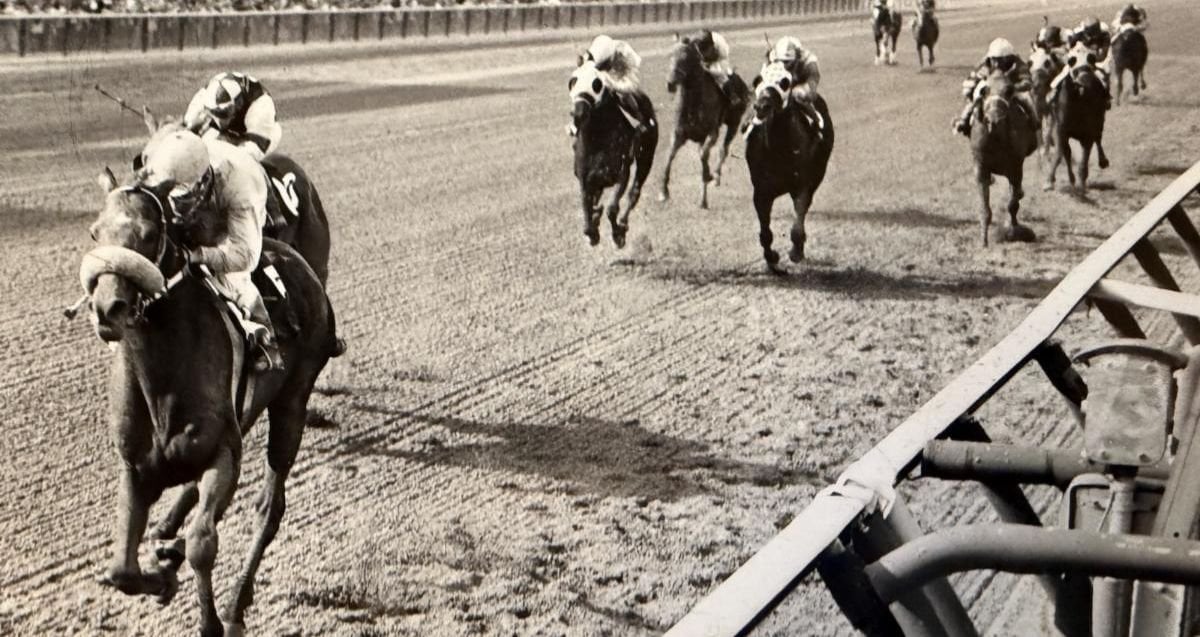
By the time the Belmont Stakes moved – temporarily - to Aqueduct Racetrack in 1963, the race named for financier August Belmont, Sr. had already known three homes: Jerome Park, at which the race was inaugurated in 1867; Morris Park, which hosted the race from 1890 - 1904; and Belmont Park, which opened in 1905.
When Aqueduct re-opened in September 1959 after a $33 million renovation [more than $377 million in today’s dollars], it was considered the finest sporting facility in the world. So when in April of 1963 the grandstand and clubhouse at Belmont Park were declared unsafe due to structural deficiencies in buildings that were more than 50 years old, The New York Racing Association, Inc. (NYRA) quickly made the decision to transfer all racing, including that year’s Belmont Stakes, to Aqueduct, nine miles to the southwest of Belmont.
Throughout the five years that it took to raze and rebuild Belmont Park, New York racing patrons would spend a lot more time at what had come to be known as the Big A. When Aqueduct had re-opened four years earlier, the city’s Transit Authority had established five Aqueduct Daily Double trains, running express from 42nd Street and Eighth Avenue in Manhattan and from Brooklyn’s Hoyt-Schermerhorn station directly to the racetrack, in addition to the regular subway service that already stopped at the facility in South Ozone Park, the only racetrack within New York City’s borders since the permanent closure of Jamaica Race Course in September 1959.
The fares for the Daily Double trains were 50 cents, more than triple the regular subway fare of 15 cents, and then as now, a racetrack sitting on a subway line offered easy and affordable access to millions of New York City residents. So essential was the subway to Aqueduct’s success that NYRA reportedly estimated early attendance numbers by multiplying the number of subway riders by four.
NYRA took the “Park” part of Belmont Park seriously, landscaping its dozens of acres with flowers and plants from on-site greenhouses; the track’s verdure was as much of its appeal as the 12-furlong oval and old-world charm and elegance. Aqueduct was less pastoral, less staid, more midcentury Modern with a touch of Brutalism. In a contemporary New York Times article, Arthur Daley characterized Belmont as a “dowager queen,” and Aqueduct as a “modern miss.”
So when the races moved to Aqueduct in the spring of 1963, so too did the customers - so many, in fact, that on June 8, the day of the first Belmont Stakes at Aqueduct, more than 53,000 showed up, setting a then record for the event.
Perhaps the most significant difference between Belmont and Aqueduct was the racing surface itself: from 1963-1967, the Belmont Stakes’ 12-furlongs would be run over a nine-furlong track, a distance never before contested at Aqueduct. As a result, the starting gate was placed on the far turn, angled out to the southeast. For that first running in 1963, only the seven outermost stalls were used, in an attempt to minimize the disadvantage of breaking from the far outside with little time to establish position before heading into the curve leading to the homestretch.
The 1963 Belmont featured the winners of both the Kentucky Derby and the Preakness. Chateaugay and jockey Braulio Baeza triumphed in Louisville by 1 1/4 lengths, with Candy Spots finishing well back in third place. Two weeks later in Baltimore, Candy Spots and Bill Shoemaker turned the tables, with Chateaugay settling for second, 3 1/2 lengths back.
On the strength of that race and a record blemished only by his loss in the Kentucky Derby, Candy Spots was the betting favorite. But under a deft ride by Baeza, one that saw him guide Chateaugay along the rail as the field of seven ran down the homestretch for the second time, the Kentucky Derby winner avenged that Preakness loss, beating Candy Spots by 2 1/2 lengths.
By the early 1960s the term “Triple Crown” was in common usage; the sweep of the Kentucky Derby, Preakness, and Belmont hadn’t been achieved since Citation did it in 1948, and racing fans were simultaneously thirsting for a ninth horse to join the sport’s immortals while at the same time bemoaning the difficulty of the series, wondering whether any horse would again win all three races. Chateaugay’s victories in the Kentucky Derby and Belmont fueled both of those reactions, which amplified the following year when Northern Dancer came to Aqueduct following comfortable wins in the first two legs of the Triple Crown.
The 1963 record for attendance at a Belmont Stakes was broken in 1964, when 61,215 showed up in the hope of seeing the first Triple Crown winner in 16 years, and the first at Aqueduct. Those hopes were crushed at the eighth pole when, after mounting a serious challenge to the frontrunning longshot Quadrangle, Northern Dancer faded to third, vanquished by the testing distance of the Belmont Stakes.
According to the New York Times, bettors - all of them on track in these days before OTB - put a world record $5,834,896 through the windows, $903,948 of that total on the Belmont Stakes, itself a record handle for the race.
“The Belmont is the third phase of the Triple Crown competition, and yet it is quite different from the other two. Generations of horsemen have regarded it as the most important and searching test of the three. But to the pragmatic horse players at the Big A yesterday, it merely was the seventh race on the program, one more outlet for investing their money,” wrote Arthur Daley in the Times. “...where Kentucky and Maryland have inbred horse lovers, New York produces horse players whose interest centers mainly on the figures in the form charts and on the mutuel boards.”
Won by Hail to All, the 1965 Belmont Stakes went off without any Triple Crown considerations, but on June 4, 1966, the bid by Kauai King to become the ninth winner of the series attracted 56,000 people who poured money through the windows, again setting a record, this time for handle on a single race in New York, when $955,602 was wagered on the Belmont.
About a third of that amount was bet on Kauai King to win, making him the 3-5 favorite; he attracted 65 percent of the $160,910 in the show pool, which inflated the payoffs for the top three finishers when he ran fourth. The failure of yet another Triple Crown hopeful horse to withstand the ‘Test of the Champion’ led the Times’ Daley to opine, “...a guy even begins to wonder if Citation will go down in history as the last of the Triple crown (sic) winners.”
Bill Boland rode Amberoid, the horse that denied Kauai King the Triple Crown; Amberoid had finished second in the Remsen Stakes and won the Wood Memorial, both at Aqueduct. Sixteen years earlier, Boland had won his first Belmont, at age 16, with Middleground in 1950; the duo had also won the Kentucky Derby that year, so Boland well knew the sting of winning two of the three races.
Based in New York, Boland knew both Belmont and Aqueduct well, but despite the difference in track configuration, he didn’t plan to ride the 1966 Belmont any differently because it was Aqueduct.
“It was more about the horse than the track,” he said by phone from his Florida home.
And while he admitted that he’d rather have won his second Belmont Stakes at Belmont Park, he dismisses any idea that a win by Kauai King would have in any way diminished the significance of the Triple Crown.
“Absolutely not,” he said. “A Triple Crown is a Triple Crown, no matter where it’s run.”
He expressed an affinity for Aqueduct, but the man who rode at all four original NYRA tracks is philosophical about its closing.
“Things happen,” the Hall of Famer said. “Jamaica went away, and I loved that track.”
In the final Belmont Stakes at Aqueduct, Damascus became the fourth horse in the five years that the race had been held in Queens to win two legs of the Triple Crown. Chateaugay had won the Kentucky Derby and the Belmont; Northern Dancer and Kauai King won the Kentucky Derby and the Preakness; and Damascus won the Preakness and the Belmont after finishing fourth as the Kentucky Derby favorite. Only 53 horses have won two of the three races; that nearly eight percent of them occurred during the Belmont’s five-year Aqueduct run may be only an obscure historical footnote, but a notable one to those who love Aqueduct and its history.
For a Triple Crown to have been completed and celebrated, there was a dream that could exist only for those five years, and it is now simply a wistful “What if?”
For much of its 132-year history, Aqueduct has existed in the shadows of Belmont Park and Saratoga Race Course, but like those tracks, Aqueduct is perfectly suited to its environment. It’s New York City’s racetrack, attracting city dwellers, rather than travelers from the suburbs. Back in 1963 when the first Belmont was contested there, at the track that at the time set the standard for race course design, amenities, and accessibility, Mr. Daley at the Times acknowledged that fusion of form and function:
“...[Aqueduct] has so much convenience and utilitarian practicality that magnetizes the horse players into compulsive attendance. It was a cinch that the first Belmont at the Big A would set a crowd record for the event…this ancient race still glowed, even in its new setting.”
*
The New York Racing Association, Inc. (NYRA) will say farewell to Aqueduct Racetrack with a memorable Closing Weekend celebration on Saturday, June 27 and Sunday, June 28. For a full listing of onsite activities and to order tickets in advance, please visit https://www.nyra.com/aqueduct/visit/farewell/.
