

Secretariat and Aqueduct: Big Red retires at the Big A
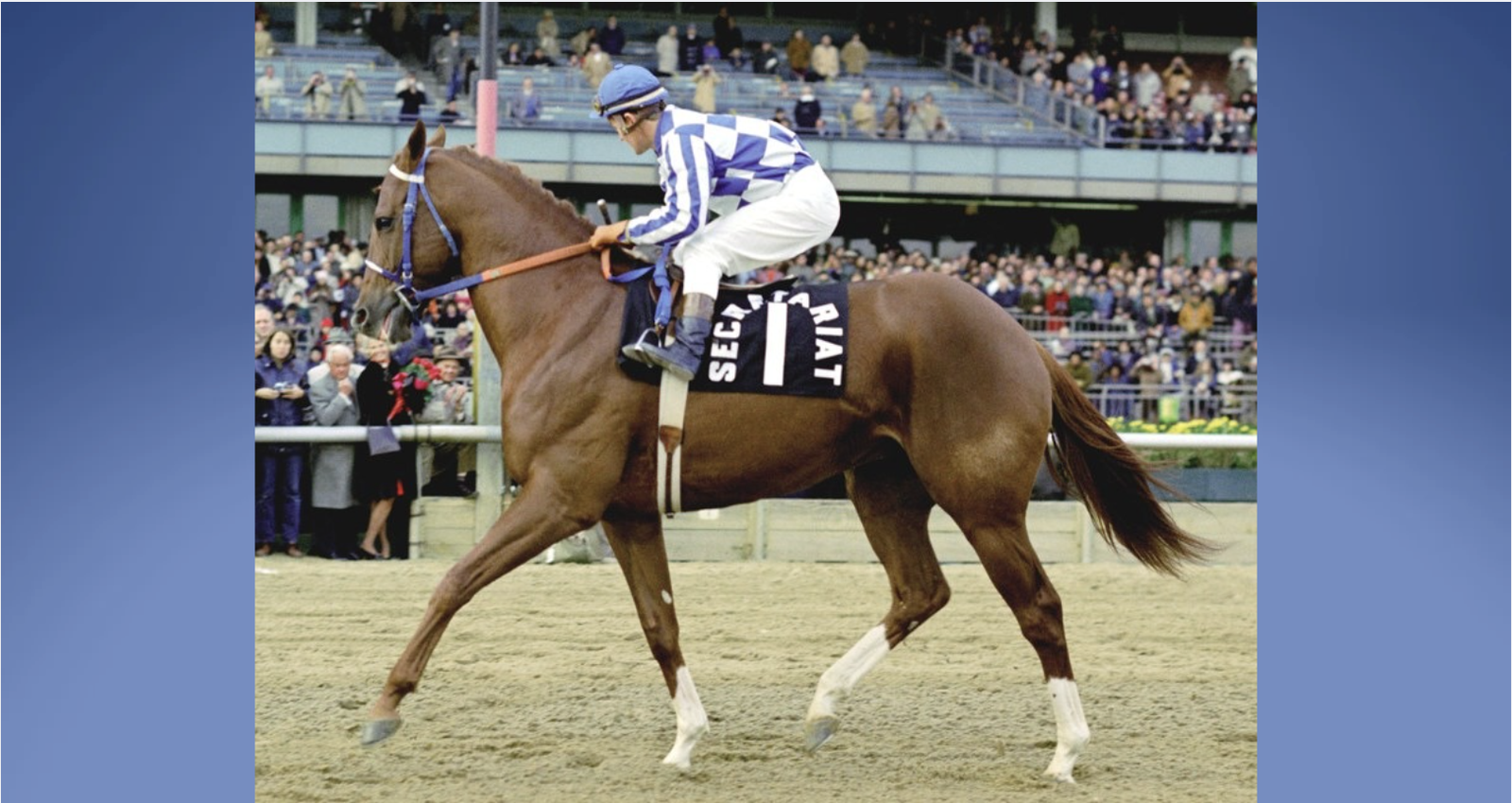
In a full-circle moment those in attendance would never forget, Aqueduct Racetrack served as both the beginning and end of the mighty Secretariat’s Triple Crown-winning career when he stepped foot on a racetrack for the final time on “Secretariat Day,” November 6, 1973.
“There’s a certain sense of relief,” Penny Tweedy, owner of Meadow Stable, said to Ed Schuyler, Jr. of The Associated Press at the ceremony. “There was a great deal of responsibility, a great deal of pressure.”
With a new and re-imagined Belmont Park opening September 18, the final race day at Aqueduct will be Sunday, June 28. The New York Racing Association, Inc. (NYRA) will pay tribute to Aqueduct with a special closing weekend to honor the legacy of the South Ozone Park oval. Details will be announced at a later date.
On Election Day of 1973 at Aqueduct, the revered son of Bold Ruler strutted in front of a crowd of 32,990 lively fans, making his way down the first homestretch that the colt had ever traversed just 16 months prior. Across that span, Secretariat accomplished feats never seen before or since in the sport of horse racing, and it all began on Independence Day in 1972.
Secretariat, a Virginia homebred for Meadow Stable trained by Hall of Famer Lucien Laurin, was given a tough test to start off his career in a 5 1/2-furlong maiden sprint over the Big A’s main track. At the start, a rival crossed over in front of the field and caused several horses to steady, including Secretariat when he was bumped and drifted back to track at the tail end of the 12-horse field. Despite the rough beginning, and more traffic down the backstretch, Secretariat made up ground with a late turn-of-foot and finished a 1 1/4-length fourth.
“He was all but knocked down at the gate,” Laurin told Teddy Cox of The Daily Racing Form ahead of the colt’s retirement day. “One of the riders told me that it was a miracle he stayed on his feet.”
He dusted himself off with six-length graduation sprinting six furlongs at the Big A next up, commencing a remarkable streak that saw him win nine of his next 10 starts, a span that would have been perfect had he not been disqualified and placed second in the Champagne at Belmont Park. Among those wins were seven stakes triumphs, including the Sanford and Hopeful at Saratoga Race Course. He won the Garden State at its namesake course to close out his 1972 Champion 2-Year-Old and Horse of the Year season in November.
Secretariat returned to action in March, and reaffirmed his affinity for the Big A with a 4 1/2-length stroll in the seven-furlong Grade 3 Bay Shore before another facile score in the one-mile Grade 2 Gotham when equaling the track record at the time [1:33 2/5 seconds]. The dominant chestnut seemed unstoppable, and was the odds-on favorite in the nine-furlong Grade 1 Wood Memorial, with the running of the race seeming like a mere formality with how he stacked up against his five rivals.
In a shocking result, Secretariat could only manage a four-length third to stablemate Angle Light in a performance that had pundits questioning the colt’s distance capability as the Wood was the farthest test of his career with an even further test in the 10-furlong Kentucky Derby awaiting. While the result was puzzling at first, Laurin discovered after the race that Secretariat was battling an abscess in his mouth, which likely hindered his effort.
What followed the Wood Memorial was one of the most famous and dominant three-race runs in the history of the sport, as Secretariat and future Hall of Fame rider Ron Turcotte posted emphatic victories in the Kentucky Derby, Preakness and Belmont Stakes, the latter by his record-establishing 31 lengths that has not been approached in any Belmont since. At Belmont Park, the blue and white checkered Secretariat Pole was erected 31 lengths from the finish line to commemorate the monstrous margin.
Along with being the first Triple Crown winner since Citation in 1948, Secretariat set the track record in both the Kentucky Derby [1:59 2/5] and Belmont Stakes [2:24], and it was later determined with hand-timing that he set a then-track record in the Preakness [1:53]. Both the Churchill Downs and Belmont Park track records still stand today, while all three remain the respective stakes records. In addition to his 1 1/2-mile track record at Belmont, he also holds the track’s nine-furlong record [1:45 2/5] set in the 1973 Marlboro Cup, which was also a world record at the time.
Secretariat also became the first and only Gotham winner to win the Kentucky Derby. The Gotham, now a Grade 3 with a $300,000 purse, will see its 74th running on Saturday for the final time at the Big A ahead of its relocation to Belmont Park next year.
Regarded as perhaps the greatest horse to ever step foot on a racetrack, the revered chestnut went on to win four of his last six races, capped by two wins on turf in Belmont’s Grade 1 Man o’ War, where he set what was then the track record [2:24 4/5] – and Woodbine’s Grade 2 Canadian International as the curtain fell on his illustrious career.
Despite making six more starts after the Belmont Stakes, Secretariat never returned to race again at Aqueduct, making his final competitive appearance over the Ozone Park oval a shocking loss. However, it was only fitting that the legend receive a hero’s sendoff back where it all began, allowing him to strut the course one last time as a beloved Champion on a cold and windy November afternoon before heading off to stud at Claiborne Farm in Kentucky.
Between the day’s third and fourth races, tens of thousands of race fans packed into Aqueduct to get a glimpse at racing’s biggest star, with NYRA handing out commemorative keychains adorned with his likeness.
Secretariat’s reach extended far beyond fans of the sport, with politicians paying homage to him and his career as well. In a letter to Tweedy, New York Governor Nelson Rockefeller penned, “Honor is certainly due. The three major tracks in New York constitute our state's largest single corporate producer of revenue, contributing as they do between $80 and $85‐million a year from the pari‐mutuel tax alone. It is sad to know that Secretariat's racing days are over, but we will be looking forward to seeing his sons and daughters burning up our racing strips in another three or four years.”
The celebrations commenced in Aqueduct’s paddock, where Secretariat was led in by devoted groom Eddie Sweat and exercise rider Charlie Davis, who was atop his pony, Billy Silver.
NYRA president Jack Krumpe – who had given the day its nickname of “Secretariat Day” – read aloud Rockefeller’s letter and presented Tweedy with a special award, and Laurin and Turcotte with commemorative plaques. Sweat and Davis were also gifted timepieces as a token of appreciation for their involvement in Secretariat’s career. Soon after, Secretariat, with Turcotte aboard as he was for 18 of his 21 starts, made his way onto the Aqueduct dirt for his final steps on a racetrack.
“Track announcer, Dave Johnson, intoned, ‘the horse is on the track,’ and the cheering swelled,” penned Joe Nichols in The New York Times.
As the famed blue and white checkered silks of Meadow Stable paraded down the stretch, Herb Goldstein of The Daily Racing Form noted Turcotte “jogged him to the quarter-pole and past the stands as the band played Auld Lang Syne.”
There was little Laurin could say that had not already been spoken. His few words quoted in The Times were appreciation for what he had accomplished with the horse of a lifetime, and ponderings of what more a 4-year-old Secretariat could have achieved.
“It’s a sad day, and yet, it’s a great day. I certainly wish that he could run as a 4‐year‐old,” he said. “He's such a great horse and he likes to work.”
Fans both young and old clamored along the fence of Aqueduct’s track apron to catch a glimpse of greatness, many pointing cameras and wielding signs with messages of love and appreciation – including one bed sheet that read, “Secretariat, we’ll miss you” – for what Secretariat gifted horse racing and the entire world of sports.
Secretariat’s popularity was evidenced by his portrayal in national media. During his historic 1973 campaign, he graced the covers of three of the country’s most-read publications in Time, Sports Illustrated and Newsweek.
His ears pricked for most of the ceremony, Secretariat, who made 15-of-21 starts in the Empire State, appeared ready and willing to take a spin around the oval for another pummeling of his challengers. But after the casual trot to bring his career full circle, it was time for Secretariat to put his racing days behind him and depart for Kentucky alongside stablemate and future Hall of Famer Riva Ridge.
Over the past five decades, Secretariat’s descendants have made their own mark on the racetrack, including Aqueduct. His sons included General Assembly, who captured the 1979 Grade 2 Gotham and 1979 Grade 2 Vosburgh at the Big A, and Pancho Villa, who won Grade 2 Bay Shore in 1985.
More recently, Secretariat’s name still appears close up in pedigrees of top horses to have run at the Big A. In November, the Listed Knickerbocker was won by Ohana Honor, whose sire Honor Code was from the last crop sired by A.P. Indy, a breed-defining maternal grandson of Secretariat. Similarly, multiple stakes-winning New York-bred Bernietakescharge, who won the state-bred Bay Ridge in December, is by Take Charge Indy, a great-grandson of Secretariat through the A.P. Indy line.
As Secretariat left the Big A, he stepped into the next chapter of his career, one that continues to influence the sport to this day. Laurin summarized the legendary chestnut to The Associated Press with simplicity and finality.
“There’ll never be another like him.”
